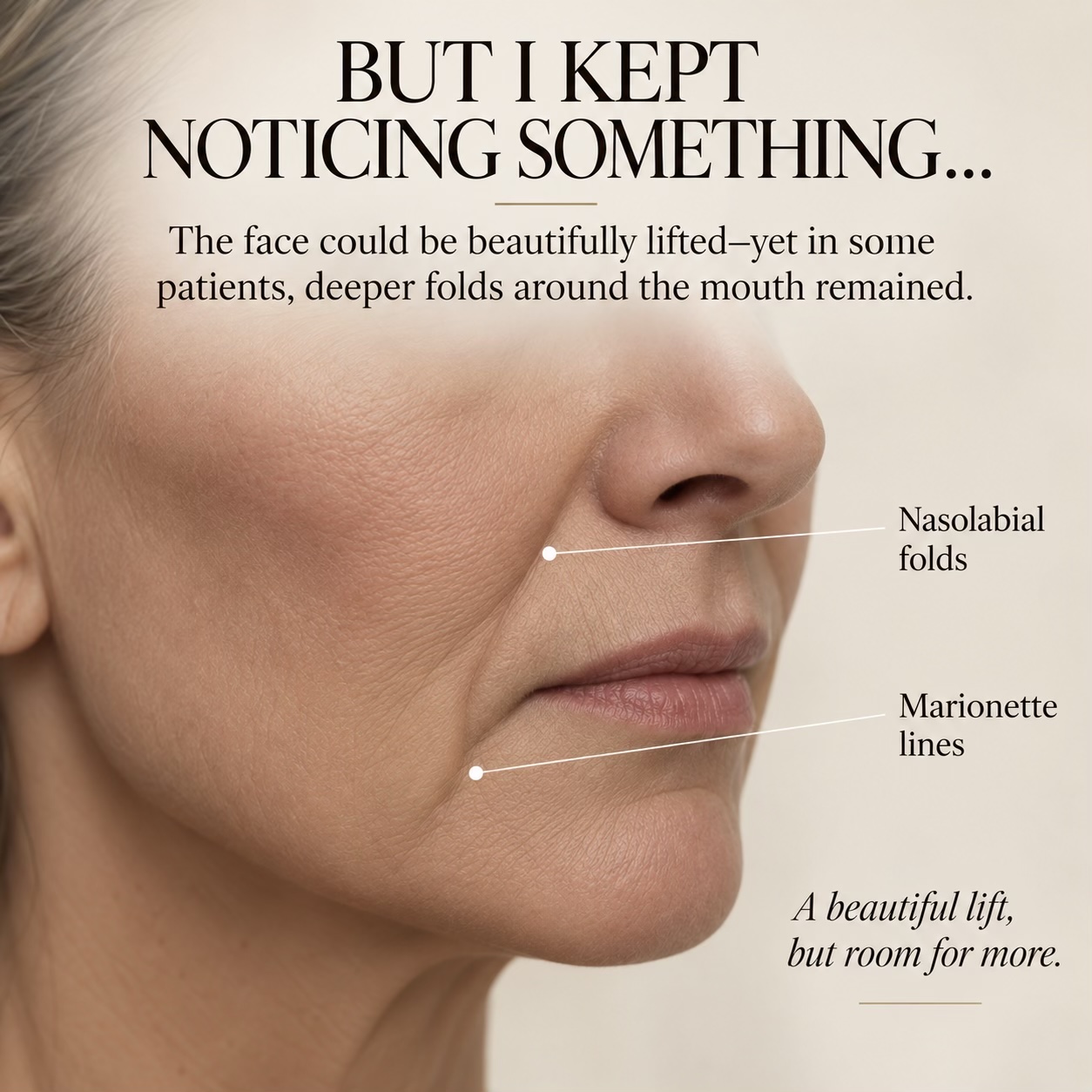
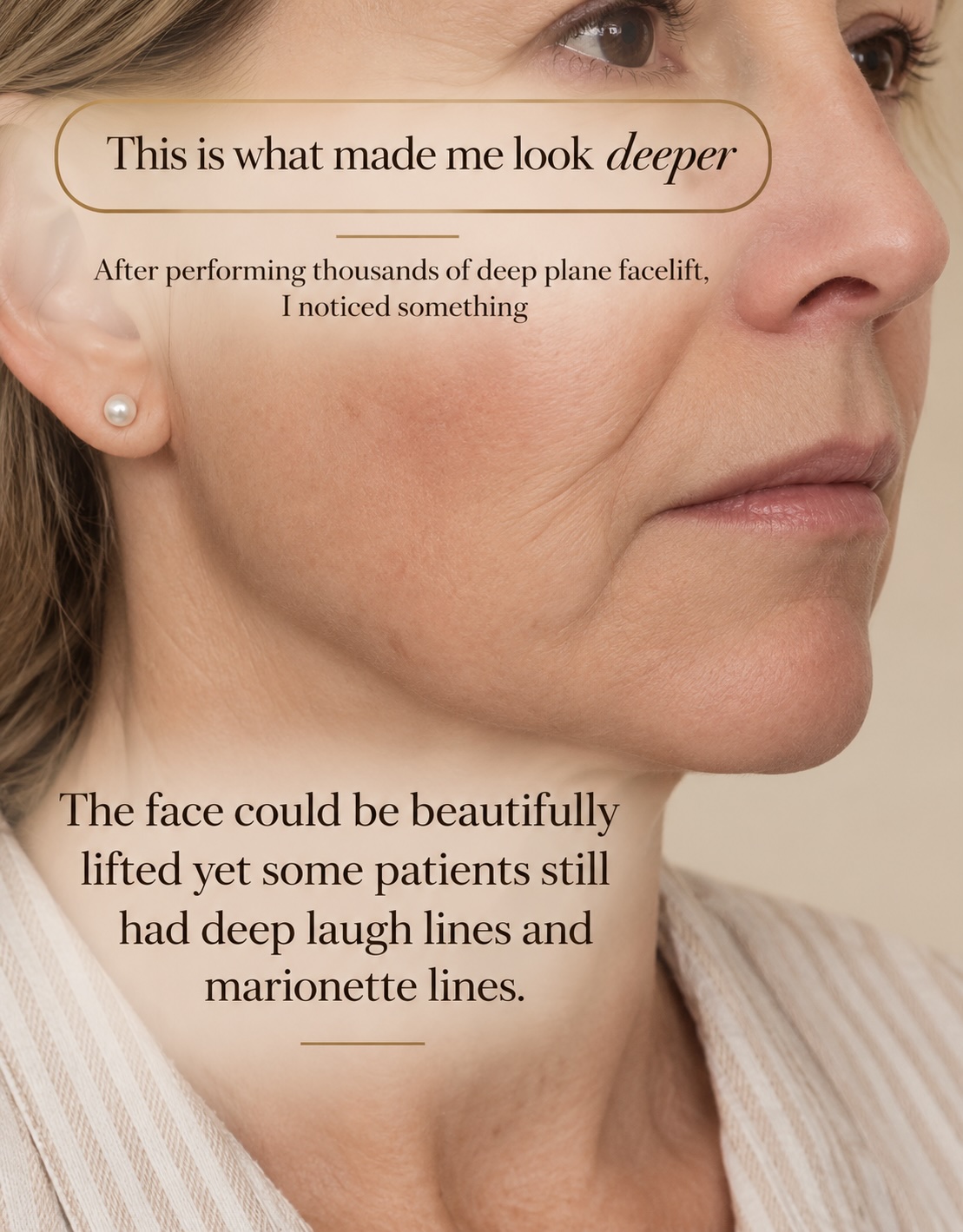
For years, I performed deep-plane and extended deep-plane facelifts. Patients would return months later with beautifully improved cheeks and jawlines, yet some still had residual marionette lines and laugh lines. As surgeons, we often told ourselves, “This is simply residual relaxation of the soft tissues after facelift surgery, and there is not much more we can do about it.” The results were very good—but to me, they were not good enough. That realization led me to look beyond “the deep plane” and begin studying the deeper tissues beneath it.

The term deep-plane facelift has become widely used to describe a facelift performed beneath the SMAS, with release of the major facial retaining ligaments. This allows the SMAS and the associated facial soft-tissue envelope to be mobilized and repositioned. This revolutionary procedure was a game changer in the world of facelift surgery because it moved the operation beyond simply removing or tightening excess skin.
Our approach begins where the traditional deep-plane facelift ends
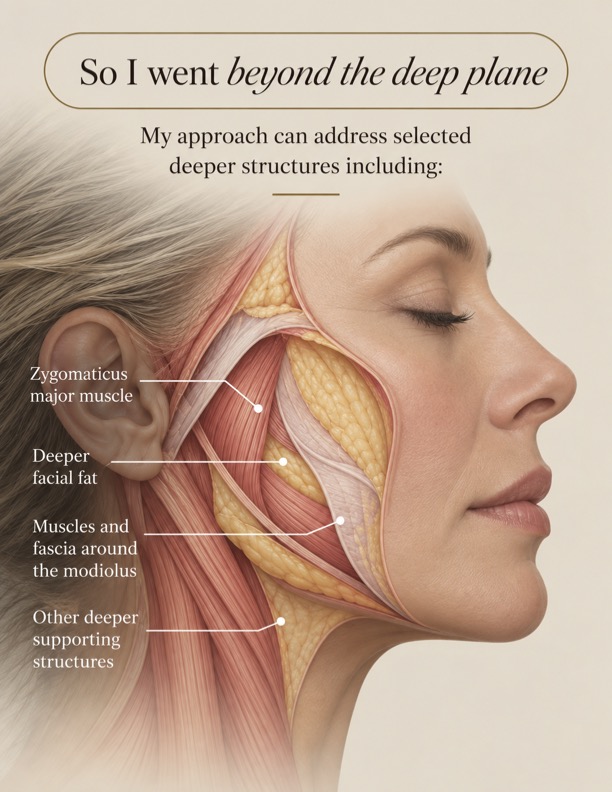
The skin, SMAS and the retaining ligaments, are not the endpoint of the operation, we evaluate the deeper anatomical structures that may continue to contribute to the patient's aging appearance.
These structures include selected facial muscles, deeper fat compartments, and the underlying fascial anatomy.
Lets go through those structures:
The Zygomaticus Major Muscle
One of the most important components of this deeper approach is the zygomaticus major muscle.
The zygomaticus major is a major muscle of facial expression that extends from the cheek bones toward the corner of the mouth. Its position and relationship with the surrounding soft tissues are important components of midface anatomy.
In some patients with pronounced deep nasolabial folds, simply releasing the anchoring ligaments over the muscle, elevating the overlying SMAS may not completely address theanatomical contributors to the fold.
My technique include partial tightening and repositioning of the zygomaticus major muscle, allowing us to address the muscular component of the aging midface rather than simply lifting the tissues overlying it.
This is fundamentally different from treating the nasolabial fold as nothing more than excess skin or a descending SMAS.
The Deeper Fat Compartments
The deeper facial fat compartments also play an important role in facial aging.
Facial fat is not a single homogeneous layer. Different compartments can enlarge, descend, or lose volume independently.
The relationship between the deep medial cheek tissues, malar region, buccal fat, and surrounding muscular and fascial structures can significantly influence the appearance of the cheek, nasolabial fold, marionette region, and jawline. Our conventional extended deep plane facelift does not address those structures.
A deeper-layer facelift therefore requires an understanding not only of where the tissues have descended, but also which deeper structures are creating the contour and the short comings that we see externally.
Where appropriate, these deeper fat compartments can be repositioned or selectively modified as part of the overall reconstruction of the facial contour.
The Fascia Beneath the SMAS
The deeper facial fascia is another important component of this approach.
Laterally, the anatomy beneath the SMAS is closely related to the parotidomasseteric fascia, which surrounds the parotid and masseteric structures. Medially, the anatomy becomes considerably more complex as the SMAS transitions into the muscles of facial expression and associated fascial structures.
Rather than treating the face as a single sheet that needs to be lifted, our approach recognizes these deeper anatomical relationships and addresses them according to the patient's individual anatomy.
And that is what differentiates Deeper plane facelift than our average extended deep plane facelift we were all so proud of.
A Different Concept of Facelift Surgery
The distinction can therefore be summarized simply:
A traditional extended deep-plane facelift releases the retaining ligaments and mobilizes the deeper soft-tissue envelope.
Our deeper-layer approach goes beyond that mobilization to address selected structures beneath the SMAS—including the zygomaticus major muscle, the muscular and fascial structures surrounding the modiolus, deeper facial fat compartments, and other underlying tissues that contribute to the patient's specific pattern of facial aging.
This is not about going deeper simply for the sake of going deeper.
It is about recognizing that different signs of facial aging can originate from different anatomical layers.
If the problem originates in a muscle, treating only the overlying SMAS may not be enough.
If the problem involves a deep fat compartment, lifting the skin may not be enough.
If the aging pattern involves the muscular and fascial structures around the corner of the mouth, simply elevating the lateral cheek may not fully address it.
The objective is therefore not to perform the deepest facelift possible.
The objective is to identify the anatomical structures responsible for each patient's aging pattern—and address those structures directly.